Office Chair Market Forecast 2035
Latest Update: June 13, 2026
The global office chair market crossed USD 14.18 billion in 2024, and that figure is just the starting point for a decade of accelerating demand [1].
The Office Chair Market Forecast 2035, Hybrid Work & Ergonomics Drive Growth story is one of structural change, not a temporary sales spike.
As hybrid work becomes the permanent default for millions of professionals worldwide, the chairs people sit in — at home, at the office, and everywhere in between, have moved from afterthought to strategic purchase.
Key Takeaways
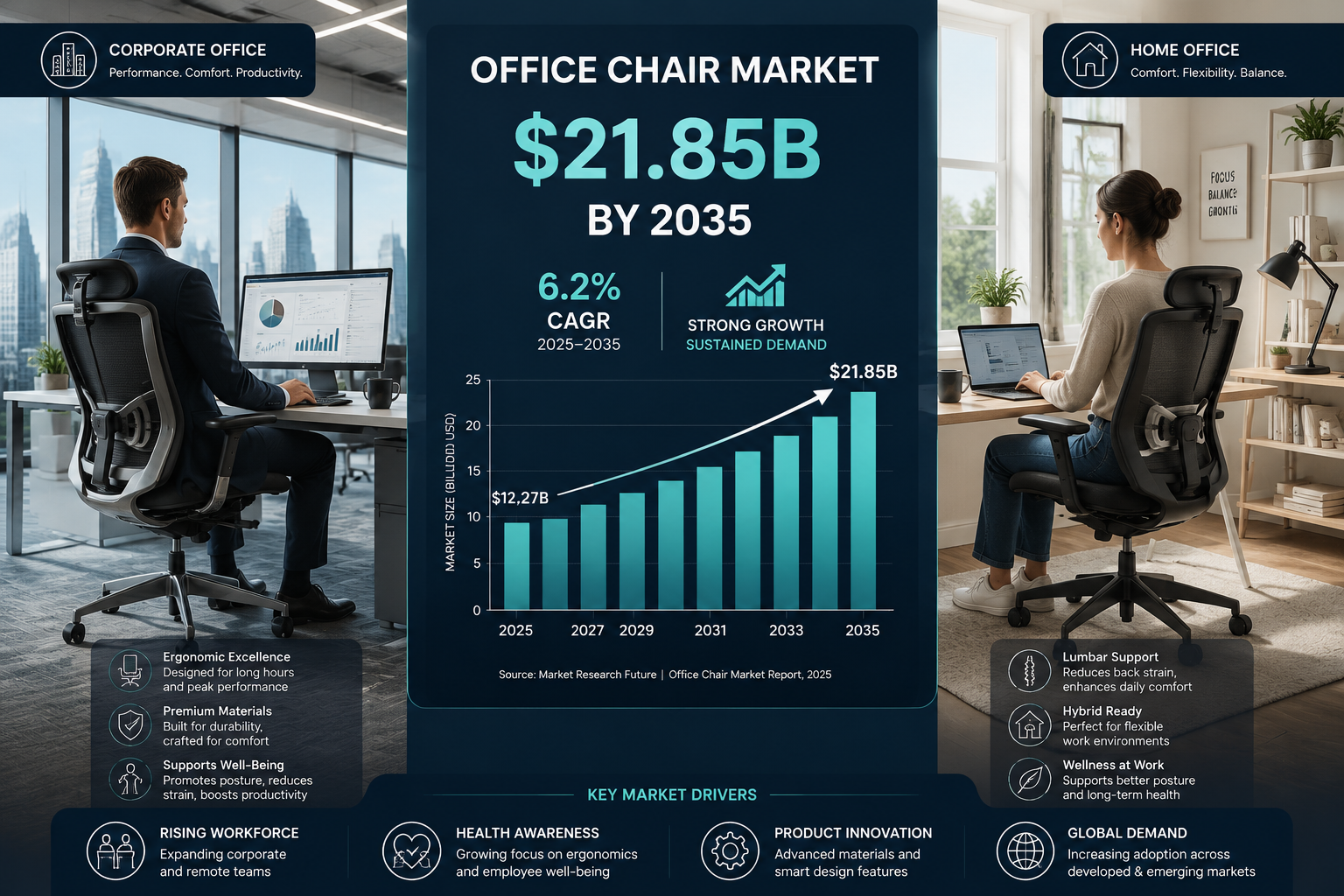
- The global office chair market is projected to reach USD 21.85 billion by 2035, growing at a 4.01% CAGR from 2025 [1].
- Hybrid work models are the single largest structural driver of sustained demand across both home and commercial segments.
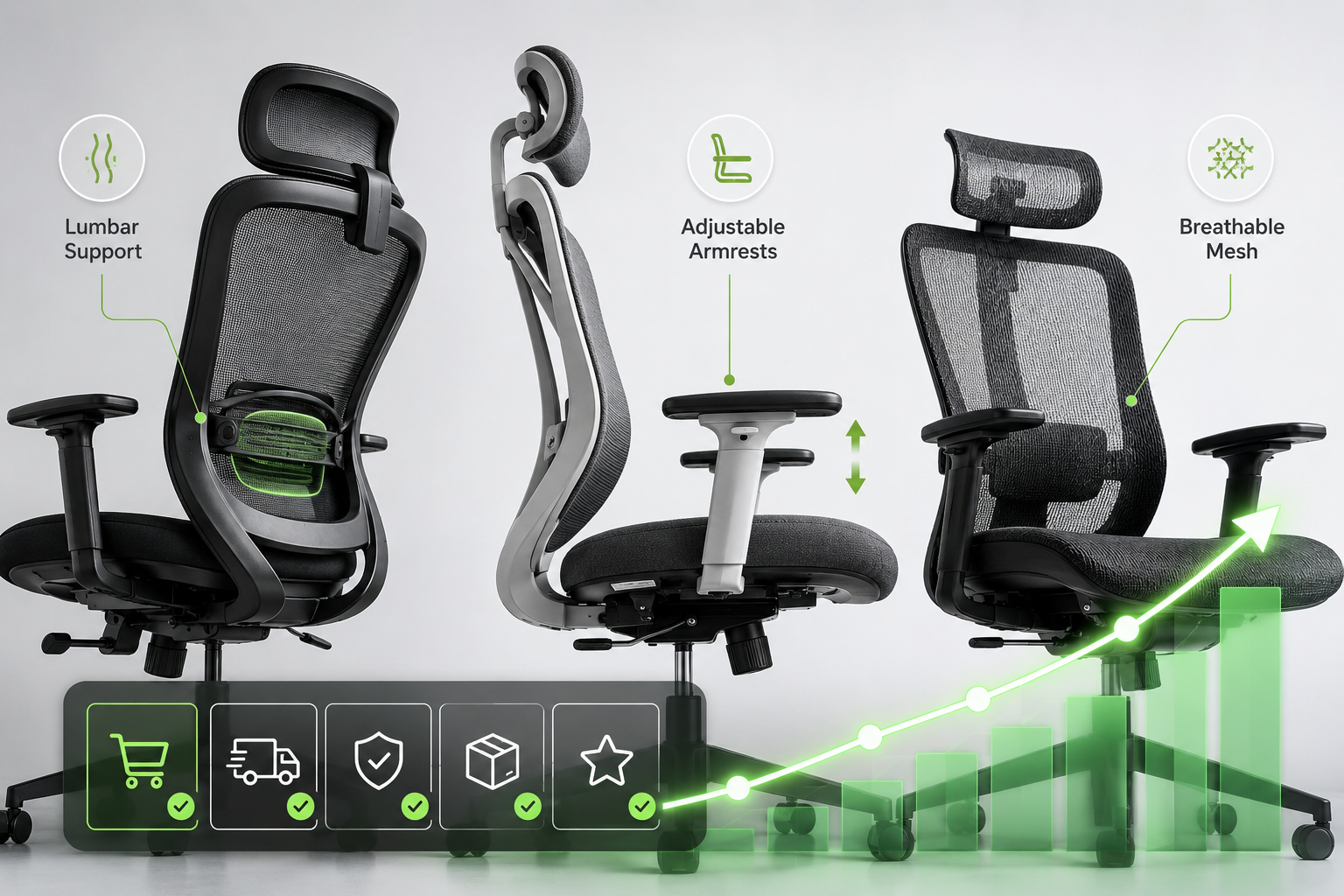
- Ergonomic features — lumbar support, adjustable armrests, breathable mesh — are shifting from premium add-ons to baseline consumer expectations.
- E-commerce is reshaping how chairs are discovered, compared, and purchased, accelerating market reach into previously underserved regions.
- Supply chain resilience and rising raw material costs remain the primary challenges facing manufacturers through 2035.
Market Size and Growth Outlook to 2035
Market Research Future values the office chairs market at USD 14.18 billion in 2024, climbing to USD 14.75 billion in 2025 and reaching USD 21.85 billion by 2035 at a 4.01% CAGR [1].
Fortune Business Insights and Research and Markets offer broadly consistent projections, reinforcing the consensus that the market is on a steady, long-term upward trajectory [6][7].
The ergonomic office chair sub-segment is growing even faster. Global Growth Insights forecasts the ergonomic chair market expanding at a notably higher rate through 2035, driven by increased awareness of musculoskeletal health and employer wellness mandates [2].
A separate analysis from Industry Today notes the ergonomic chair segment could reach USD 12.4 billion by 2035 at a 5.1% CAGR, underscoring how the premium tier is outpacing the broader category [3].
What These Numbers Mean for Buyers and Businesses
For individual buyers, rising market competition means more product choice at every price point. For businesses, from small startups to large enterprises, the data signals that ergonomic seating investment is no longer optional. Companies that ignore seating quality risk higher absenteeism, lower productivity, and talent retention challenges.
“The shift is not just about comfort — it is about employers recognizing that a quality chair is a productivity tool, not a furniture expense.”
Understanding why office chairs can be expensive helps buyers make informed decisions rather than defaulting to the cheapest option available.
How Hybrid Work Models Are Reshaping the Office Chair Market Forecast 2035
The rise of hybrid work is the most consequential structural driver behind the Office Chair Market Forecast 2035: Hybrid Work & Ergonomics Drive Growth narrative.
When employees split their time between corporate offices and home setups, demand for seating effectively doubles — employers must furnish office workstations while employees simultaneously invest in home office chairs.
This dual-demand dynamic is well-documented. IndexBox research highlights hybrid work and ergonomic premiumization as the twin engines pushing the compact and standard ergonomic chair markets higher through 2035 [9].
The Business Research Company similarly identifies remote and hybrid work adoption as a primary accelerant for ergonomic office chair sales globally [5].
Home Office Segment Leads Growth
The home office segment has become the fastest-growing channel within the broader market. Consumers who previously relied on employer-furnished seating are now making independent purchasing decisions, and they are increasingly informed. Search behavior, online reviews, and social media recommendations all influence buying choices in ways that did not exist a decade ago.
For workers building out a home workspace, finding the right fit matters enormously. Resources like finding comfortable ergonomic office chairs nearby have become genuinely useful starting points for buyers navigating a crowded product landscape.
Corporate Refresh Cycles Accelerate
On the commercial side, many organizations are redesigning office layouts to support hot-desking and flexible seating arrangements. This accelerates replacement cycles for existing chair inventory and creates bulk purchasing opportunities. Wholesale and volume purchasing channels are growing as a result, particularly in North America and Europe.
The Ergonomics Premium: Demand Drivers and Design Trends
Ergonomic features have moved from luxury to expectation. Market growth reports confirm that lumbar support, adjustable armrests, seat depth customization, and breathable mesh backs are now the most-searched features among online chair buyers [4][10].
The ergonomic office furniture market broadly, including chairs, desks, and accessories, is expanding in parallel, creating an ecosystem of products designed around human-centered workspace design [8].
Key ergonomic features driving purchasing decisions in 2026 include:
- Lumbar support systems — adjustable or contoured lower-back support to reduce spinal strain
- Seat height and depth adjustment — accommodates a wide range of body types, from shorter workers to taller individuals
- Armrest adjustability — 3D or 4D armrests that reduce shoulder and neck tension
- Breathable mesh backs — improve airflow during long work sessions
- Recline tension control — allows users to shift posture throughout the day
For buyers who want to understand how these features translate into real-world comfort, exploring comfortable ergonomic office chairs for better posture provides a practical framework for evaluation.
Health Awareness as a Market Catalyst
Growing public awareness of back pain, repetitive strain injuries, and sedentary lifestyle risks is pushing consumers toward higher-specification chairs.
Employers are also responding to occupational health regulations in several markets, making ergonomic compliance a procurement requirement rather than a preference.
This trend is expected to intensify through 2035 as aging workforces in developed economies demand greater physical support during long work hours.
Pairing a quality ergonomic chair with office exercises for better posture is increasingly recommended by occupational health professionals as a combined approach to workplace wellness.
E-Commerce and Distribution: Expanding Market Reach
E-commerce has fundamentally altered the office chair distribution landscape. Online channels now account for a growing share of total sales, enabling brands to reach consumers in markets where physical retail presence is limited.
The ability to compare specifications, read verified reviews, and access competitive pricing has democratized access to premium ergonomic seating.
Key e-commerce dynamics shaping the market through 2035:
| Factor | Impact |
|---|---|
| Direct-to-consumer brands | Lower prices, faster innovation cycles |
| Marketplace aggregators | Broader product discovery, price transparency |
| Virtual try-on and AR tools | Reduced return rates, higher buyer confidence |
| Subscription and leasing models | Lower upfront cost barrier for consumers |
Smaller brands and regional manufacturers are leveraging e-commerce platforms to compete with established players like Herman Miller, Steelcase, Haworth. This competitive pressure is accelerating product innovation and keeping price points accessible across market segments.
Key Challenges Facing the Market Through 2035
Despite strong growth projections, the Office Chair Market Forecast 2035, Hybrid Work & Ergonomics Drive Growth outlook is not without headwinds.
Raw material costs remain volatile. Steel, aluminum, foam, and fabric prices fluctuate with global commodity markets, compressing manufacturer margins and occasionally pushing retail prices higher.
Supply chain complexity — particularly for brands sourcing components across multiple countries, creates lead time uncertainty. The disruptions of the early 2020s have prompted many manufacturers to diversify sourcing, but full resilience remains a work in progress.
Market saturation in mature regions — North America and Western Europe, means growth in these markets will be driven primarily by replacement cycles and premiumization rather than new buyer acquisition. Emerging markets in Asia-Pacific, Latin America, and the Middle East represent the highest-growth opportunity through 2035.
Sustainability expectations are also rising. Consumers and corporate procurement teams increasingly require transparency around materials sourcing, recyclability, and carbon footprint, adding compliance costs for manufacturers.
Conclusion: Actionable Insights for 2026 and Beyond
The Office Chair Market Forecast 2035: Hybrid Work & Ergonomics Drive Growth trajectory is clear: sustained, broad-based expansion driven by structural shifts in how and where people work.
For consumers, the takeaway is straightforward, investing in a quality ergonomic chair is one of the highest-return workspace decisions available in 2026.
Actionable next steps:
- Audit your current seating. If your chair lacks adjustable lumbar support, seat depth control, or proper armrest positioning, it is likely costing you in comfort and productivity.
- Prioritize ergonomic features over aesthetics. Use verified feature checklists when comparing models. Consider chairs that support better posture as a starting benchmark.
- Leverage e-commerce for better value. Online channels offer the widest selection and most competitive pricing. Compare across multiple platforms before purchasing.
- For businesses, treat seating as a wellness investment. Ergonomic chair programs reduce absenteeism and support talent retention — both measurable returns on investment.
- Watch the premium segment. As ergonomic features become standard, the next wave of innovation — smart sensors, posture feedback, adaptive materials — will emerge first in premium products.
The market data is unambiguous. Whether outfitting a home office or a corporate floor, the demand for better seating is only growing, and the industry is responding with more options, better technology, and broader accessibility than at any point in history.
References
[1] Office Chairs Market 12018 – https://www.marketresearchfuture.com/reports/office-chairs-market-12018
[2] Ergonomic Office Chair Market 124827 – https://www.globalgrowthinsights.com/market-reports/ergonomic-office-chair-market-124827
[3] Ergonomic Chair Market Rises To 124 Usd Billion By 2035 At 51 Cagr Amid Remote Work Revolution – https://industrytoday.co.uk/market-research-industry-today/ergonomic-chair-market-rises-to-124-usd-billion-by-2035-at-51-cagr-amid-remote-work-revolution
[4] Ergonomic Office Chair Market 110178 – https://www.marketgrowthreports.com/market-reports/ergonomic-office-chair-market-110178
[5] Ergonomic Office Chairs Global Market Report – https://www.thebusinessresearchcompany.com/report/ergonomic-office-chairs-global-market-report
[6] Office Chairs Market 103870 – https://www.fortunebusinessinsights.com/office-chairs-market-103870
[7] Office Chairs Market Global Strategic Business – https://www.researchandmarkets.com/reports/6106425/office-chairs-market-global-strategic-business
[8] Ergonomic Office Furniture Market 108818 – https://www.industryresearch.biz/market-reports/ergonomic-office-furniture-market-108818
[9] Compact Ergonomic Chair Market Forecast Points Higher Toward 2035 Driven By Hybrid Work And Small Space Living Trends – https://www.indexbox.io/blog/compact-ergonomic-chair-market-forecast-points-higher-toward-2035-driven-by-hybrid-work-and-small-space-living-trends/
[10] Ergonomic Office Chairs Market Size Share Competitive Landscape And Trend Analysis Report – https://www.einpresswire.com/article/918123821/ergonomic-office-chairs-market-size-share-competitive-landscape-and-trend-analysis-report