Anthros Chair V2
Last updated: May 27, 2026
Quick Answer: The Anthros Chair V2 is a medical-grade ergonomic office chair built around a patented two-piece independent back support system and a low-pressure seat design validated through pressure mapping technology.
It costs around $1,495 and is best suited for professionals who sit 6–10 hours daily and have existing back pain or posture concerns.
It competes directly with the Herman Miller Embody but takes a more clinically focused approach to spinal alignment.
Key Takeaways
- The Anthros Chair V2 uses a two-piece independent backrest that moves with your spine rather than forcing a fixed position
- Its seat cushion is engineered for low-pressure distribution, reducing the ischial pressure points that cause discomfort over long sessions
- Priced at approximately $1,495, it sits at the premium end of the ergonomic chair market
- The chair accommodates users from 5’0″ to 6’5″ and supports up to 300 lbs
- Anthros offers a 5-year warranty and a 30-day return window
- The V2 improves on the V1 with better lumbar adjustment range, refined seat foam, and updated armrest mechanics
- Common complaints include the high price, limited color options, and a learning curve for optimal adjustment
- Long-term users report sustained comfort and reduced back pain after several months of daily use
- It is not the right chair for casual or part-time desk users, the price-to-use ratio only makes sense for full-time sitters
- Cheaper alternatives exist, but none replicate the dual-backrest biomechanical approach at this price tier
What Makes the Anthros Chair V2 Different from Other Ergonomic Chairs?
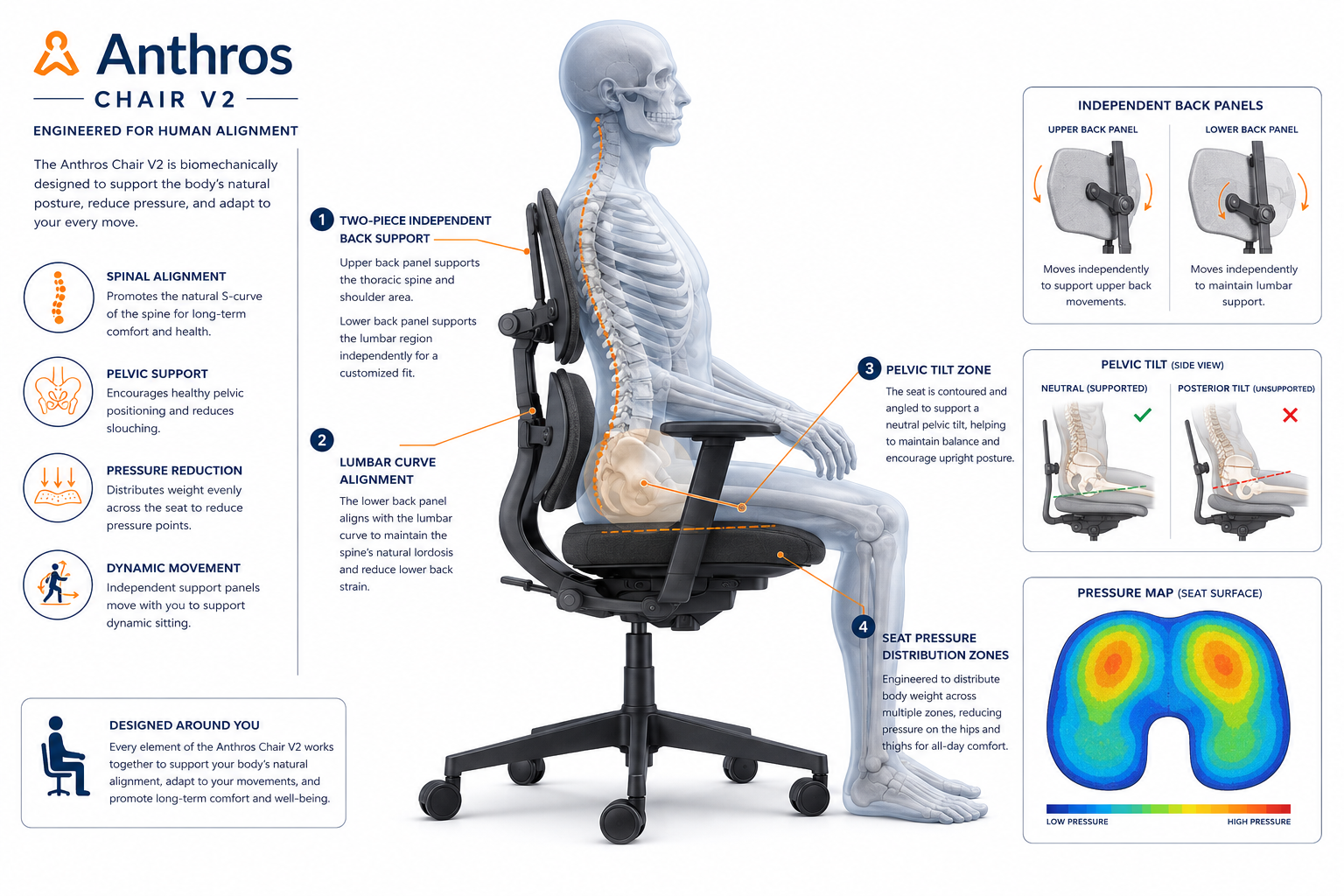
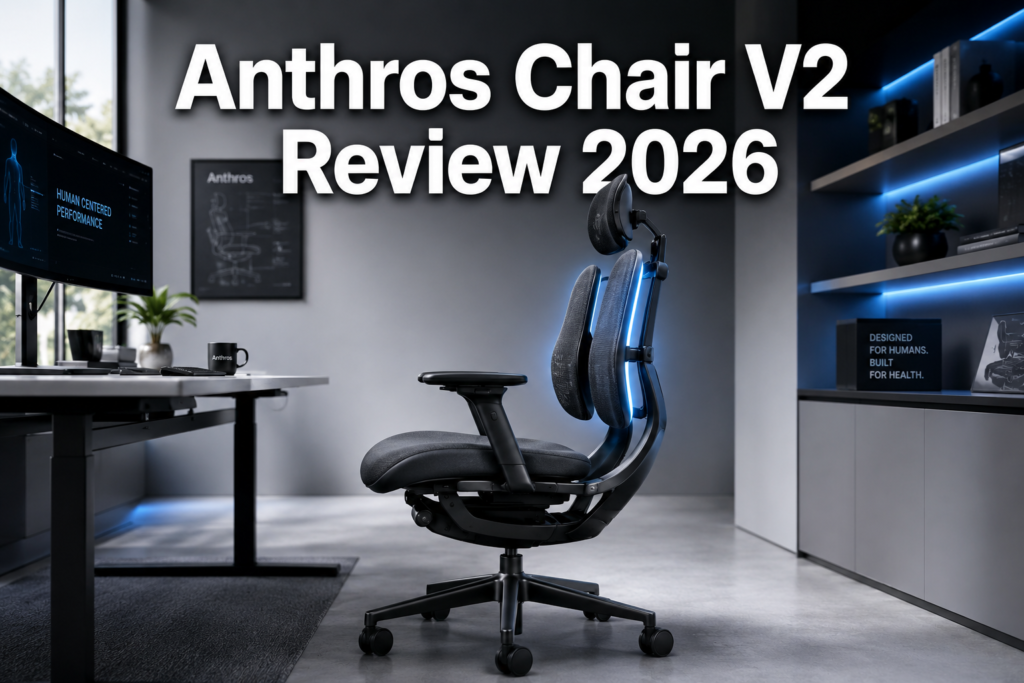
The Anthros Chair V2 stands apart from most ergonomic chairs because of its two-piece independent back support system, which allows the upper and lower backrest panels to move independently.
Most chairs use a single-piece back that either locks you into one position or flexes uniformly. The Anthros design adapts to your spine’s natural S-curve as you shift throughout the day.
Here is what sets it apart technically:
- Independent dual backrest panels: The upper thoracic panel and lower lumbar panel articulate separately, so movement in your shoulders doesn’t force your lumbar into an awkward position
- Pelvic anchoring design: The seat and lower back panel work together to tilt the pelvis into a neutral position, which is the foundation of healthy spinal alignment
- Pressure-mapped seat foam: Anthros used pressure mapping data during development to engineer a seat that distributes weight away from the ischial tuberosities (sit bones), reducing the “hot spots” that cause numbness and fatigue
- Medical-grade build standards: The chair is designed with input from physical therapists and ergonomic engineers, not just industrial designers
“The Anthros chair’s dual-backrest concept is genuinely different from what you find in most premium chairs, it’s built around spinal mechanics rather than aesthetics.” BTOD.com review
If you’ve struggled with chairs that feel fine for two hours but cause stiffness by hour five, the independent back system is the specific engineering detail worth paying attention to.
How Much Does the Anthros Chair V2 Cost?
The Anthros Chair V2 retails at approximately $1,495 as of 2026, purchased directly through the Anthros website. Occasional promotional discounts have appeared, but the brand does not regularly discount the chair through third-party retailers.
Price context:
ChairPrice (approx.) Warranty:
Anthros Chair V2, $1,495, 5 years.
Herman Miller Embody, $1,795, 12 years.
Steelcase Leap V2, $1,200–$1,500, 12 years.
Humanscale Freedom, $1,100–$1,400, 15 years.
The Anthros V2 is not the most expensive chair in its class, but it does carry a shorter warranty than competitors like Herman Miller and Steelcase. For buyers focused purely on warranty value, that gap matters.
For buyers focused on the specific biomechanical design approach, the price is competitive.
If budget is a concern, our guide to why office chairs are expensive explains what drives premium pricing and whether it’s justified for your situation.
Is the Anthros Chair Good for People with Back Pain?
Yes, the Anthros Chair V2 is specifically engineered to address the root causes of seated back pain, making it one of the more clinically credible options in the consumer ergonomic market.
The dual-backrest system targets two common pain drivers:
- Lumbar collapse: When a chair doesn’t support the natural inward curve of the lower back, the lumbar spine flattens, compressing discs and straining muscles. The Anthros lower panel holds the lumbar curve actively.
- Pelvic posterior tilt: Most people unconsciously tuck their pelvis when sitting, which flattens the lumbar and loads the sacrum. The Anthros seat angle encourages anterior pelvic tilt, which restores the natural spinal S-curve.
Long-term users on Reddit’s r/OfficeChairs report that after switching from the V1 to the V2, back pain symptoms reduced noticeably within the first few weeks of adjusted use.
One user noted 17 months of daily use with “zero regression” in comfort, a meaningful data point for anyone weighing durability against price.
Choose this chair if: You sit more than 6 hours daily, have diagnosed lumbar disc issues, or have tried multiple chairs without finding lasting relief.
It may not help if: Your back pain is caused by factors outside seating, such as weak core muscles, poor monitor height, or a non-ergonomic desk setup.
Pairing the chair with practical tips for relieving office chair back pain will get you better results than the chair alone.
What Are Common Complaints About the Anthros Chair V2?
No chair at this price point is without trade-offs. Based on user reviews and expert evaluations, the most consistent complaints about the Anthros Chair V2 are:
- Price: At $1,495, it’s a significant investment. Users who don’t sit full-time feel the cost isn’t justified.
- Limited color and aesthetic options: The chair has a clinical, functional look that doesn’t suit every office aesthetic. Color choices are narrow compared to competitors.
- Adjustment learning curve: The two-piece back system requires proper setup to work correctly. Users who don’t take time to dial in the fit report less benefit. Anthros provides setup guides, but it still takes 15–30 minutes to configure correctly.
- Shorter warranty than competitors: Five years versus Herman Miller’s 12-year warranty is a real gap, especially at this price.
- Armrest range: Some users with wider frames or specific desk heights find the armrest adjustment range limiting.
- No headrest option: For users who recline frequently or are taller than 6’2″, the lack of a headrest is a notable omission.
None of these complaints are dealbreakers for the right buyer, but they are worth weighing honestly before purchasing.
Can I Use the Anthros Chair If I’m Shorter Than 5’6″?
Yes, the Anthros Chair V2 is designed to accommodate users as short as 5’0″, which makes it more inclusive than several competitors that effectively start at 5’4″ or taller.
The seat height adjusts to a low enough position for shorter users to keep their feet flat on the floor, a non-negotiable for proper pelvic positioning.
The lumbar panel height is also independently adjustable, so shorter users can position it correctly for their torso length rather than relying on a fixed lumbar bump.
For shorter users specifically:
- Confirm your desk height is compatible (ideally 26–28 inches for users under 5’5″)
- Use the seat depth adjustment to avoid pressure behind the knees
- The lower backrest panel should sit at the curve of your lower back, not your mid-back, take time to set this correctly
Our guide to office chairs for shorter people covers additional fit considerations if you’re under 5’4″.
How Does the Anthros Chair V2 Compare to the Herman Miller Embody?
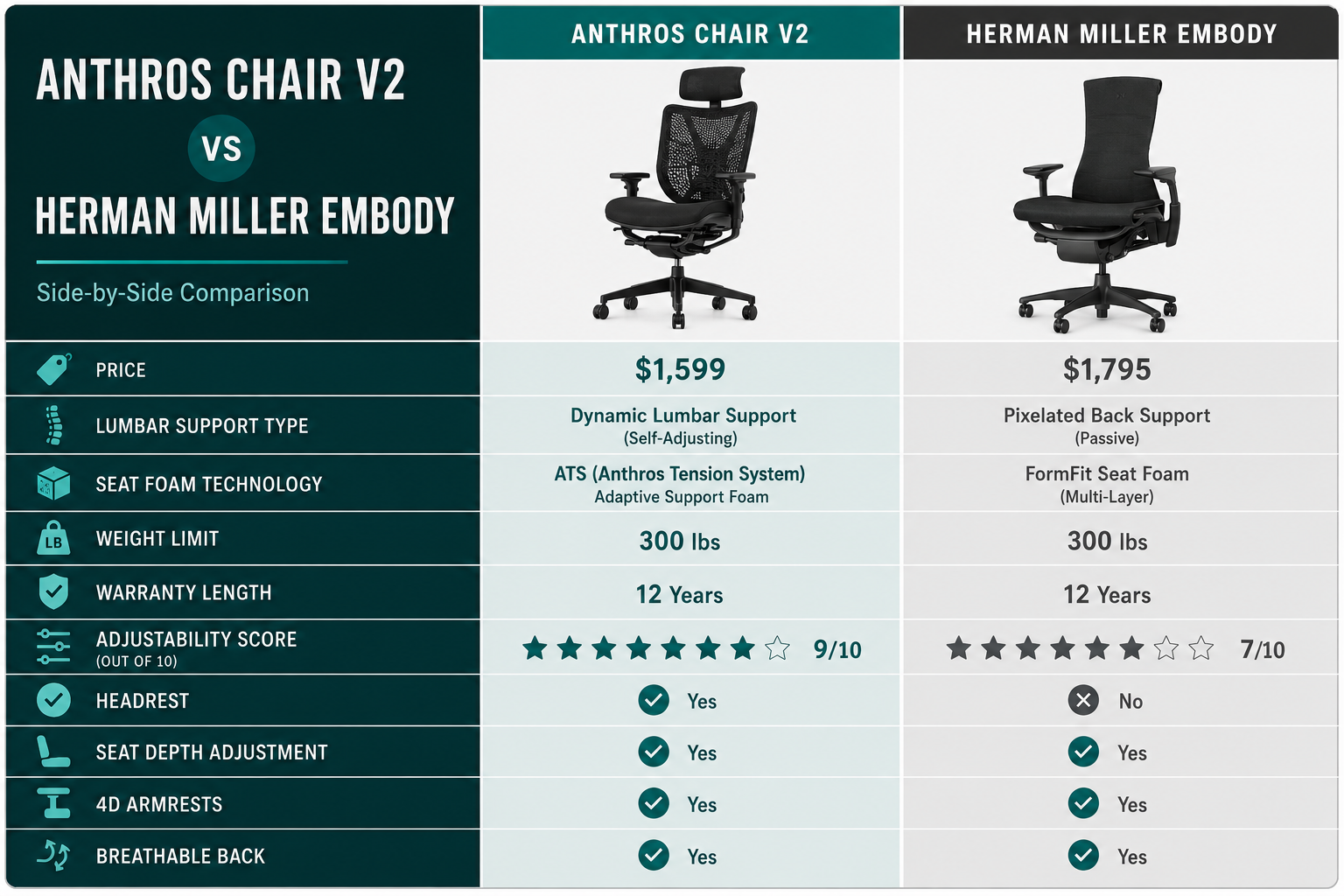
The Anthros Chair V2 and Herman Miller Embody are both premium ergonomic chairs targeting full-time desk workers, but they take fundamentally different engineering approaches.
Herman Miller Embody:
- Uses a pixelated support matrix that distributes pressure across the back
- Single-piece back that flexes as a unit
- 12-year warranty, strong resale value
- Better brand recognition and wider retail availability
- Starts around $1,795
Anthros Chair V2:
- Two-piece independent back that adapts to spinal movement separately
- Clinically focused pelvic anchoring design
- 5-year warranty
- Direct-to-consumer only
- Starts around $1,495
The Embody wins on warranty length and brand trust. The Anthros wins on targeted lumbar mechanics and pelvic alignment specificity. Users with diagnosed lumbar issues or chronic lower back pain tend to prefer the Anthros approach.
Users who want a more “set it and forget it” chair with long-term brand support often prefer the Embody.
Choose Anthros V2 if: Spinal alignment precision and lower back pain relief are your primary goals.
Choose Embody if: You want a longer warranty, broader retail support, and a more flexible return policy.
Are There Cheaper Alternatives to the Anthros Chair?
Yes, there are capable ergonomic chairs at lower price points, though none replicate the Anthros V2’s dual-backrest system exactly.
Alternatives worth considering:
- Steelcase Leap V2 (~$1,200–$1,500): Excellent lumbar support, long warranty, widely available refurbished
- Humanscale Freedom (~$1,100–$1,400): Strong recline mechanics, self-adjusting recline tension
- Branch Ergonomic Chair (~$500): Best value under $600, good adjustability for the price
- ELABEST X100 (~$300–$400): Solid budget option, see our ELABEST X100 review for details
If you’re not sitting 6+ hours daily, a mid-range chair with solid lumbar support will serve you well at a fraction of the cost. The Anthros V2 is a precision tool for a specific problem, it’s not necessary for everyone.
For budget-conscious buyers, our office chairs clearance deals page lists current discounts on quality chairs.
What’s the Weight Limit and Who Is the Anthros Chair V2 Built For?
The Anthros Chair V2 supports users up to 300 lbs and accommodates heights from 5’0″ to 6’5″. This covers a broad range, though users above 6’3″ may find the backrest height slightly short for full thoracic coverage.
The chair is primarily designed for:
- Knowledge workers and professionals sitting 6–10 hours per day
- People with existing lumbar disc issues, sciatica, or chronic back pain
- Ergonomics-conscious buyers who want a clinically validated seating solution
It is less suited for:
- Users who alternate frequently between sitting and standing (a standing desk setup changes the calculus)
- People who primarily use chairs for short sessions under 3 hours
- Anyone prioritizing gaming aesthetics or reclining/lounging use
For users on the heavier end of the spectrum, our guide to comfortable office chairs for big people covers additional options with higher weight capacities.
How Long Is the Warranty on the Anthros Chair, and What Are the Return Policies?
The Anthros Chair V2 comes with a 5-year manufacturer’s warranty covering defects in materials and workmanship. This is shorter than the 12-year warranties offered by Herman Miller and Steelcase, which is a legitimate concern for buyers planning to use the chair for a decade or more.
Return policy: Anthros offers a 30-day return window from the date of delivery. The chair must be returned in its original condition.
Given the assembly required and the adjustment period needed to properly configure the chair, 30 days is a reasonable but not generous window, make sure you spend time in the first two weeks dialing in the fit rather than leaving it to the last few days.
Shipping: Anthros ships within the continental United States. Delivery timelines vary, but most orders arrive within 5–10 business days. The chair ships partially assembled in a single box.
How Hard Is It to Assemble the Anthros Chair V2?
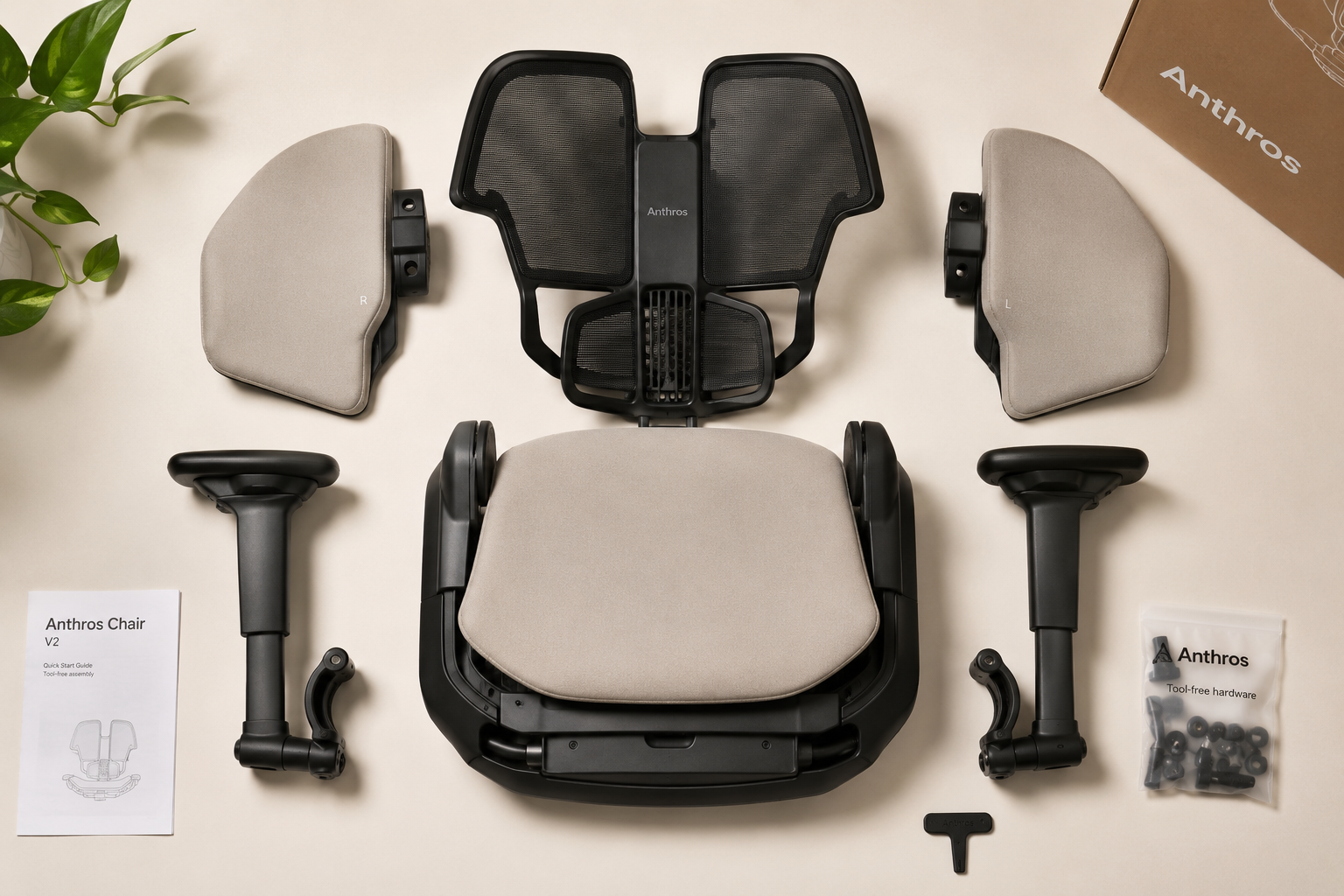
Assembly is straightforward and takes most users 20–35 minutes without professional help. The chair ships with all necessary hardware and a clear instruction guide. No special tools are required beyond what’s included in the box.
Assembly steps (general):
- Attach the base casters (press-fit, no tools needed)
- Insert the gas cylinder into the base
- Attach the seat mechanism to the cylinder
- Connect the lower backrest panel to the seat
- Attach the upper backrest panel
- Install armrests
- Adjust all settings to your body dimensions
The most important step happens after assembly: proper ergonomic adjustment. Anthros provides video guides and a setup checklist.
Skipping this step is the most common reason users report the chair “doesn’t work” the dual-backrest system only performs as designed when positioned correctly for your specific body.
Can the Anthros Chair Adjust for Different Body Types?
Yes, the Anthros Chair V2 offers a comprehensive range of adjustments that make it adaptable across a wide spectrum of body types. This is one area where it outperforms many single-adjustment-point chairs in its class.
Available adjustments:
- Seat height (pneumatic)
- Seat depth (forward/backward slide)
- Seat angle (forward tilt)
- Lower backrest height and angle
- Upper backrest height and angle
- Armrest height, width, and pivot
- Recline tension and recline lock
The two-piece back is particularly valuable for body type variation because torso proportions differ significantly between people of the same height.
A 5’8″ person with a long torso needs lumbar support positioned differently than a 5’8″ person with a short torso, the independent panels accommodate this in a way a fixed single-piece back cannot.
For users with specific conditions like sciatica, pairing the chair’s adjustability with targeted sciatica relief strategies will produce better outcomes than either approach alone.
Do Professional Gamers or Office Workers Recommend the Anthros Chair V2?
The Anthros Chair V2 has gained traction primarily among professional office workers, remote workers, and ergonomics enthusiasts rather than the gaming community.
Its clinical design aesthetic and focus on posture mechanics appeal more to people treating sitting as a health issue than as a lifestyle product.
Wired’s review called it a strong contender for professionals who spend the majority of their workday seated, noting the pressure-mapped seat design as a standout feature.
PCMag highlighted its medical-grade positioning and the dual-backrest concept as genuinely differentiated from mainstream ergonomic chairs.
On Reddit’s r/OfficeChairs, long-term users (17+ months) report that the V2 improved meaningfully on the V1’s lumbar adjustment range and seat foam density, with most noting the upgrade was worth the cost for daily users.
Gamers who prioritize recline range, headrests, and aesthetic customization tend to look elsewhere. But for the office professional logging 8-hour days, the recommendation consensus is consistently positive.
Conclusion: Should You Buy the Anthros Chair V2 in 2026?
The Anthros Chair V2 is one of the most biomechanically specific ergonomic chairs available to consumers in 2026.
Its two-piece independent back support system, pelvic anchoring design, and pressure-mapped seat foam address the actual mechanical causes of seated discomfort rather than just adding padding and lumbar bumps.
Buy it if:
- You sit 6+ hours daily and have persistent lower back pain
- You’ve tried multiple ergonomic chairs without lasting relief
- You’re willing to spend time on proper adjustment setup
- The $1,495 price fits your budget for a long-term health investment
Skip it if:
- You sit fewer than 4 hours per day
- You need a 10+ year warranty for peace of mind
- Budget is a primary constraint (strong alternatives exist under $600)
- You want gaming aesthetics, a headrest, or a wide color selection
Actionable next steps:
- Visit the Anthros website to review the current spec sheet and sizing guide
- Watch Anthros’s setup video before assembly to maximize the chair’s performance
- If budget is a concern, explore our lumbar support chair guide for alternatives at multiple price points
- If you decide to purchase, use the full 30-day return window to properly configure and evaluate the chair, don’t judge it in the first three days
The Anthros Chair V2 isn’t a chair for everyone. But for the right buyer, it’s one of the most thoughtfully engineered seats in the market today.
FAQ
Q: Is the Anthros Chair V2 worth the price?
For full-time desk workers with back pain, yes. The dual-backrest system and pressure-mapped seat address real ergonomic problems. For part-time or casual users, the price is harder to justify.
Q: What is the weight limit for the Anthros Chair V2?
The Anthros Chair V2 supports users up to 300 lbs and accommodates heights from 5’0″ to 6’5″.
Q: How does the Anthros V2 differ from the V1?
The V2 improved the lumbar adjustment range, updated the seat foam density, and refined the armrest mechanics based on user feedback from the V1. Long-term users consider the V2 a meaningful upgrade.
Q: Does Anthros ship internationally?
As of 2026, Anthros primarily ships within the continental United States. Check the Anthros website for current international shipping availability.
Q: Can I try the Anthros Chair before buying?
Anthros does not operate physical showrooms. The 30-day return policy is the primary trial mechanism. Some ergonomic consultants and corporate wellness programs may have demo units available.
Q: Is the Anthros Chair good for sciatica?
The pelvic anchoring design and lumbar support system can help reduce sciatic nerve compression caused by poor seated posture. It is not a medical treatment, but many users with sciatica report improvement.
Q: How long does the Anthros Chair V2 last?
The 5-year warranty covers defects, but long-term users report the chair holding up well beyond that with normal use. Build quality is consistent with the premium price.
Q: Does the Anthros Chair V2 have a headrest?
No. The Anthros Chair V2 does not include a headrest. This is a common complaint from taller users and those who recline frequently.
Q: What colors does the Anthros Chair V2 come in?
Color options are limited compared to competitors. Check the Anthros website for current available finishes, as options have expanded slightly since the V1.
Q: Is assembly difficult?
No. Most users complete assembly in 20–35 minutes using the included hardware and instructions. The more important task is the post-assembly ergonomic adjustment.
References
[1] Watch – https://www.youtube.com/watch?v=M-nKtNxQDAE
[2] Anthros Chair V2 – https://www.wired.com/review/anthros-chair-v2/
[3] Anthros V2 Chair Worth The Hype – https://www.btod.com/blog/anthros-v2-chair-worth-the-hype/
[4] Anthros Chair – https://me.pcmag.com/en/health-fitness/23126/anthros-chair
[5] anthros – https://www.anthros.com
[7] Anthros V2 Chair – https://www.anthros.com/anthros-v2-chair
[8] In The Media – https://www.anthros.com/in-the-media