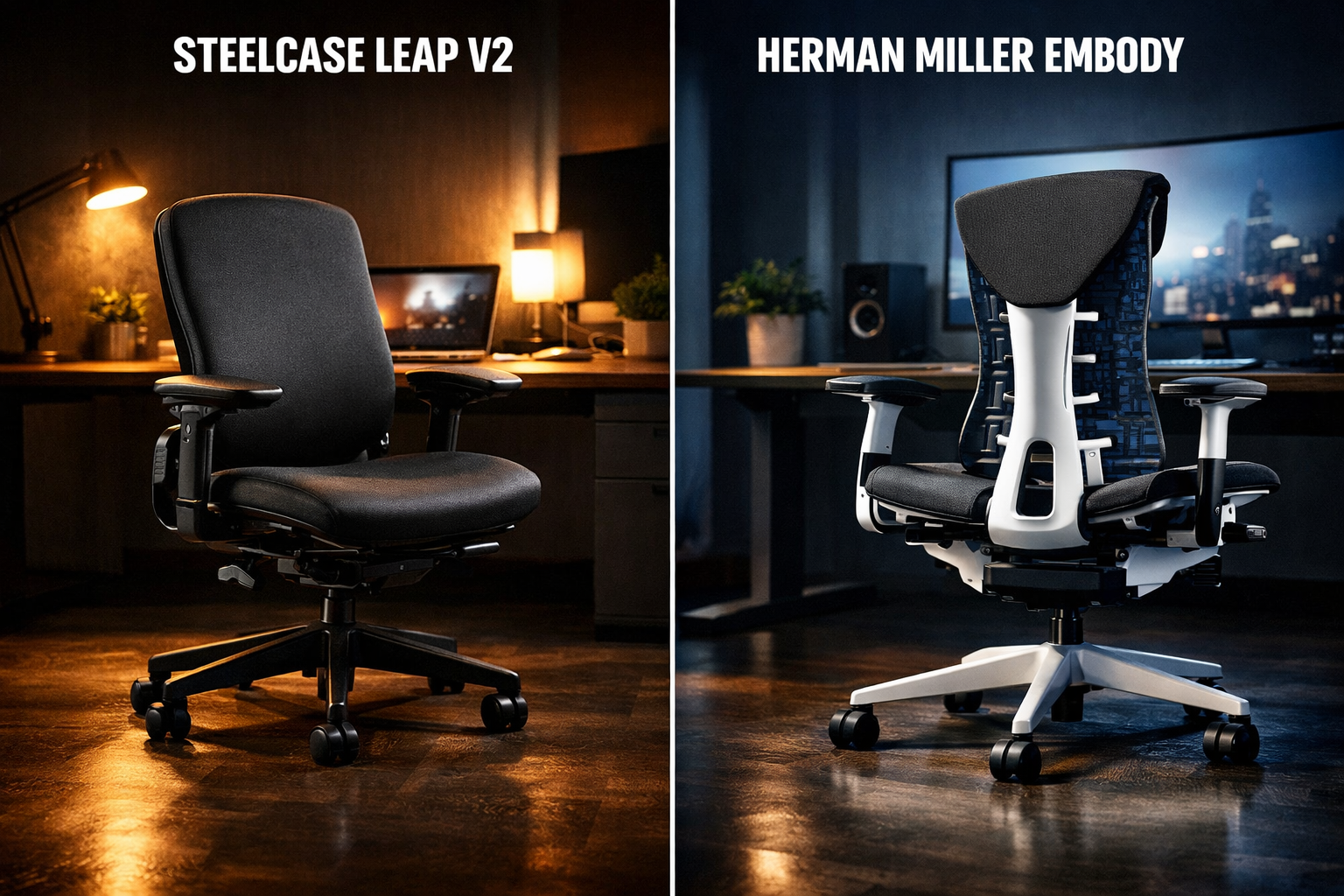
Steelcase Leap V2 vs Embody
When you’re spending 8-12 hours a day at your desk, your office chair isn’t just furniture, it’s an investment in your health, productivity, and long-term comfort. The Steelcase Leap V2 and Herman Miller Embody represent the pinnacle of ergonomic seating, but they take distinctly different approaches to supporting your body.
With price tags exceeding $1,500, choosing between these premium chairs requires careful consideration of your specific needs, body type, and work style.
This comprehensive comparison will break down everything you need to know about these two industry-leading ergonomic chairs, helping you make an informed decision that you’ll appreciate for years to come.
Quick Comparison Table
| Feature | Steelcase Leap V2 | Herman Miller Embody |
|---|---|---|
| Price (New) | $998 – $2,000 | $1,495 – $2,045 |
| Price (Refurbished) | ~$649 | Varies by seller |
| Warranty | 12 years | 12 years |
| Lumbar Support | Adjustable height & firmness | Integrated pixelated support |
| Headrest | Optional (additional cost) | Not available |
| Best Feature | LiveBack technology & adjustability | Pressure distribution & posture support |
| Recline Range | Good (some limitations) | Excellent |
| Ideal For | Users prioritizing lumbar support | Users prioritizing circulation & movement |
Steelcase Leap V2: The Adjustability Champion
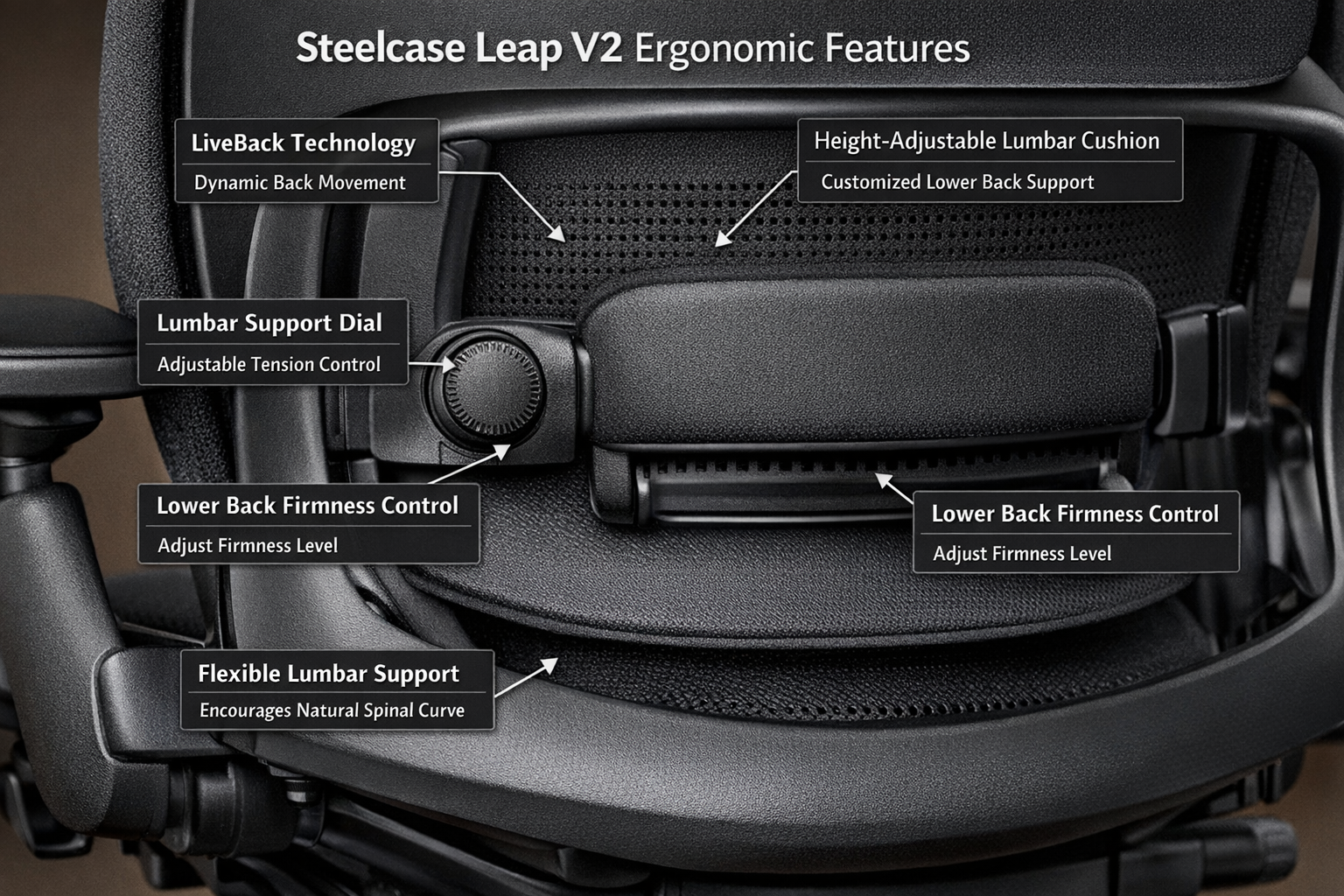
The Steelcase Leap V2 has earned its reputation as one of the most versatile ergonomic chairs on the market. Its claim to fame is the LiveBack technology, which allows the backrest to change shape as you recline, mimicking the natural movement of your spine.
✅ Pros
- Exceptional adjustability with over 20 different adjustment points, allowing precise customization for virtually any body type
- Superior lumbar support with both height and firmness adjustments—a standout feature for those with lower back issues
- Excellent build quality with a robust 12-year warranty that demonstrates Steelcase’s confidence in durability
- Flexible backrest that encourages natural movement without feeling restrictive
- Comfortable for marathon sessions with users reporting comfort during 10+ hour workdays
- Wide availability of refurbished models at significantly lower prices
❌ Cons
- High upfront investment with new models ranging from $998-$2,000
- Optional headrest issues including limited adjustability, poor stability, and additional cost
- Firmer seat cushion that some users find less plush than competitors
- Recline limitations compared to Herman Miller’s smoother, deeper recline mechanism
- Missing features like back height adjustment and forward seat tilt (though these are niche requirements)
Key Features
The Leap V2 LiveBack technology is its defining characteristic. The backrest flexes independently from the seat, maintaining consistent support whether you’re sitting upright or reclining. The four-way adjustable arms move up, down, forward, backward, and pivot inward or outward—crucial for proper keyboard and mouse positioning.
The Natural Glide System allows you to recline while keeping your feet flat on the floor and your eyes on your screen, reducing neck strain. The lower back firmness control is particularly noteworthy, letting you dial in exactly how much lumbar support pressure you need.
Who It’s Best For
The Steelcase Leap V2 excels for individuals who:
- Require strong, customizable lumbar support for existing back issues
- Appreciate having granular control over every aspect of their seating position
- Work long hours and need a chair that encourages healthy movement
- Have specific body proportions that require precise adjustment
- Want a durable investment backed by an industry-leading warranty
If you’re exploring options for back-friendly office chair options or need chairs to ease lower back pain, the Leap V2’s adjustable lumbar system makes it a top contender.
Herman Miller Embody: The Circulation Innovator
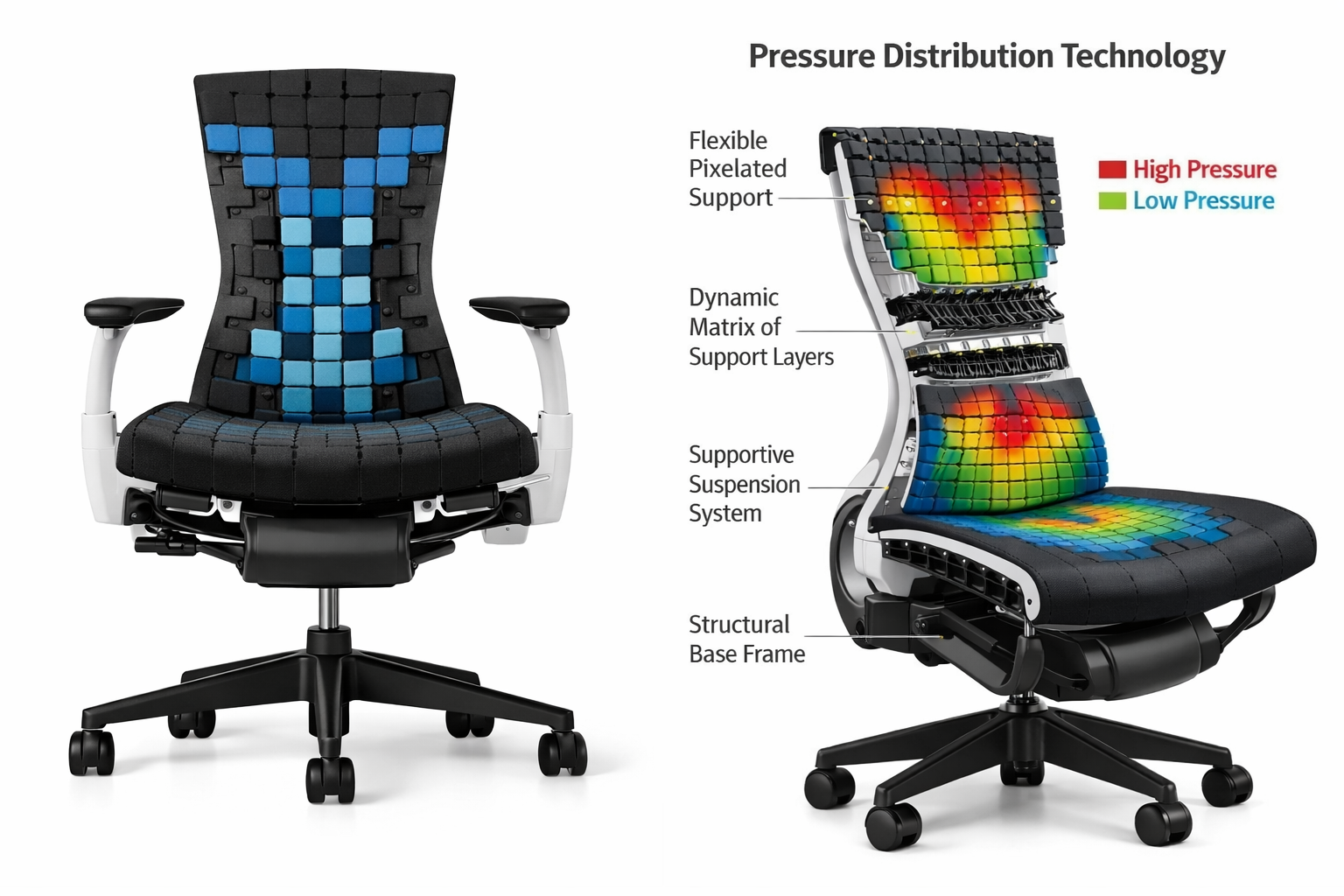
The Herman Miller Embody takes a radically different approach to ergonomic seating. Rather than focusing on adjustability, it emphasizes automatic support that adapts to your body’s movements while promoting healthy circulation and spinal alignment.
✅ Pros
- Unmatched pressure distribution through the pixelated support system that reduces pressure points and improves blood flow
- Automatic postural support that encourages healthy sitting without constant manual adjustment
- Exceptional build quality with premium materials and a 12-year warranty
- Iconic modern design with extensive customization options for fabrics and finishes
- Promotes healthy movement with a backrest designed to support micro-movements throughout the day
- Wide body type compatibility that works well for various sizes and shapes
❌ Cons
- Premium pricing starting at $1,495 and reaching over $2,000 for fully configured models
- Learning curve as the full range of adjustments may feel unfamiliar to new users
- No integrated headrest which can be a dealbreaker for those who want head and neck support
- Distinctive aesthetic that may clash with traditional office décor
- Less cushioning in the lumbar area on standard models compared to the Gaming Embody variant
- Limited refurbished availability compared to Steelcase options
Key Features
The Embody’s BackFit adjustment is unique—a single dial that simultaneously adjusts the chair’s depth and lumbar support curve. The pixelated support system distributes your weight across dozens of individual support points, reducing pressure concentration that can impede circulation during long sitting sessions.
The Backfit adjustment allows the backrest to conform to your spine’s natural curve, while the seat and back work together to keep your pelvis in a healthy, neutral position. The armrests offer four-way adjustability, and the tilt limiter lets you restrict the recline range to your preference.
Who It’s Best For
The Herman Miller Embody is ideal for:
- Professionals spending extensive hours seated who prioritize long-term spinal health
- Users who experience circulation issues or numbness during prolonged sitting
- Those seeking an investment piece with cutting-edge ergonomic technology
- Individuals who prefer automatic support over manual adjustments
- Anyone wanting a modern, statement-making design in their workspace
For those interested in choosing the right office chair with a focus on posture, the Embody’s design philosophy aligns perfectly with chairs that support better posture.
Head-to-Head: Where They Differ
Adjustability vs. Automatic Support
The Leap V2 gives you control over nearly every aspect of your sitting position. If you’re someone who likes to tinker and optimize, you’ll appreciate having separate controls for lumbar height, lumbar firmness, seat depth, and back angle.
The Embody, conversely, simplifies adjustments while relying on its intelligent design to provide appropriate support automatically. This approach works brilliantly for many users but may feel less customizable to those accustomed to granular control.
Lumbar Support Philosophy
The Leap V2’s adjustable lumbar support is more traditional and aggressive. You can move it up or down to target your specific pain points and adjust the firmness from gentle to quite pronounced. This makes it excellent for users with specific lower back issues or those recovering from injuries.
The Embody’s lumbar support is integrated into its overall backrest design. Rather than a distinct lumbar pad, the entire back flexes and conforms to your spine. This distributed approach promotes overall spinal health but may feel less targeted if you have a specific problem area.
Comfort for Different Body Types
Both chairs accommodate a wide range of body types, but with different strengths. The Leap V2’s extensive adjustability makes it particularly suitable for chairs for shorter office workers and chairs for taller office workers alike, as you can fine-tune every dimension.
The Embody’s automatic adjustment system works well across body types but truly shines for average-to-tall users. The seat depth and back height work for most people, though some petite users may find the seat depth runs slightly long even at its minimum setting.
Price and Value Proposition
The Leap V2 offers a lower entry price point and significantly more affordable refurbished options. At around $649 refurbished, it provides premium ergonomics at a more accessible price point. For budget-conscious buyers exploring affordable office chairs for comfort, the refurbished Leap V2 represents exceptional value.
The Embody commands a premium, with even base configurations starting around $1,495. However, its unique pressure distribution technology and circulation benefits justify the cost for users who experience specific issues with prolonged sitting.
Buying Guide: What to Consider
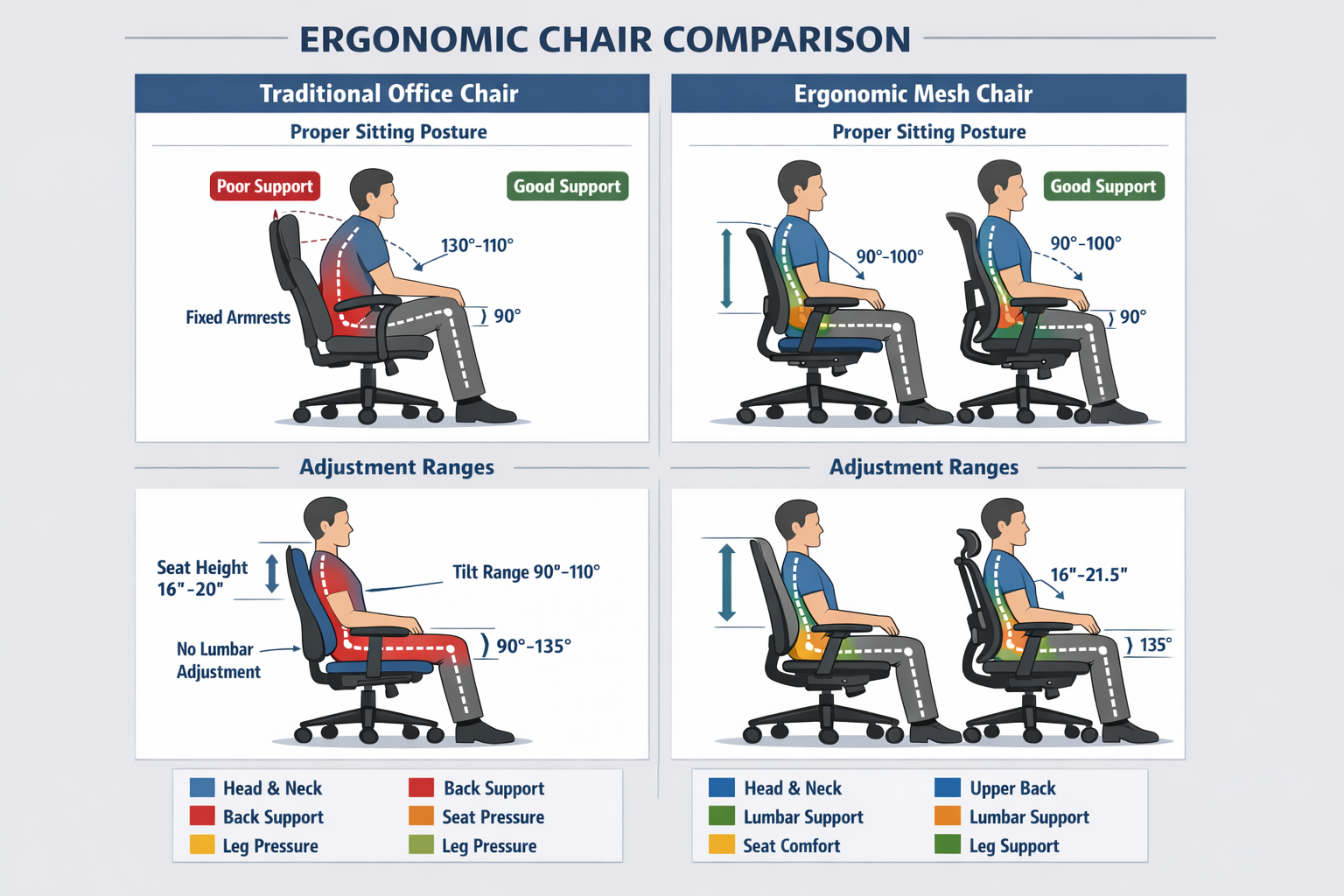
Your Primary Pain Points
Choose the Leap V2 if:
- You have specific lower back pain that requires targeted lumbar support
- You experience discomfort that you can pinpoint to specific areas
- You’ve had success with traditional lumbar support systems in the past
Choose the Embody if:
- You experience numbness, tingling, or circulation issues during long sitting sessions
- Your discomfort is more diffuse rather than concentrated in one area
- You’re focused on preventive ergonomics rather than addressing existing acute issues
Your Work Style
Choose the Leap V2 if:
- You frequently shift between tasks requiring different postures (typing, reading, phone calls)
- You like to recline occasionally but spend most time in an upright position
- You want the flexibility to adjust your chair throughout the day
Choose the Embody if:
- You maintain relatively consistent postures during your workday
- You value a chair that supports healthy micro-movements automatically
- You prefer fewer adjustments and more “set it and forget it” functionality
Budget Considerations
If budget is a primary concern, the Leap V2 offers more flexibility. The refurbished market for Steelcase chairs is robust, with quality units available for $649-$800. The new price range also starts lower, making it more accessible.
The Embody requires a more substantial investment with limited budget-friendly options. However, both chairs’ 12-year warranties mean you’re looking at a cost-per-year of use that’s quite reasonable when viewed as a long-term investment in your health.
Aesthetic Preferences
The Leap V2 has a more traditional executive chair appearance that blends into most office environments. It’s available in numerous fabric and color options but maintains a conservative profile.
The Embody makes a statement with its distinctive pixelated back and modern silhouette. If your workspace has contemporary design sensibilities, the Embody can serve as a focal point. In traditional settings, it may feel out of place.
Space and Desk Compatibility
Both chairs have substantial footprints, but the Embody’s base is slightly wider. Measure your workspace, particularly if you’re working in a smaller home office. The Leap V2’s more compact base may be advantageous in tighter spaces.
Frequently Asked Questions
Which chair is better for sciatica or lower back pain?
The Steelcase Leap V2 generally receives higher marks from users with specific lower back conditions, including sciatica. Its adjustable lumbar support allows you to target the exact area causing discomfort and dial in the appropriate firmness level. The ability to adjust lumbar height is particularly beneficial for sciatica sufferers who need support at a specific vertebral level. For more options, see our guide on chairs for sciatica relief options.
The Embody’s distributed support approach works well for general back health and prevention but may feel less targeted if you’re dealing with acute pain in a specific area.
Can I add a headrest to either chair?
The Leap V2 offers an optional headrest, though it’s frequently criticized for limited adjustability and stability issues. It’s an additional cost and doesn’t integrate as seamlessly as you might expect for a premium chair.
The Embody does not offer a headrest option at all. Herman Miller’s design philosophy emphasizes that the chair should support your spine and pelvis, allowing your head to balance naturally. If headrest support is non-negotiable for you, the Leap V2 is your only option between these two, though you may want to explore other models entirely.
How do these chairs compare for larger or heavier users?
Both chairs officially support users up to 300-400 pounds (depending on configuration), but the Leap V2 is generally recommended more strongly for larger users. Its robust frame and firmer seat cushion hold up better over time for heavier individuals. The adjustable seat depth also helps accommodate larger body frames.
The Embody works well for many larger users, particularly those who are tall, but some heavier users report the seat cushion compressing more quickly. For dedicated options, consider exploring chairs for big and tall users.
Is the Gaming Embody worth the extra cost over the regular Embody?
The Gaming Embody (around $1,900) features additional foam layers in the seat and back, copper-infused cooling foam, and different color options. For pure ergonomics, the differences are minimal—the core support technology is identical.
If you’re a gamer who spends extremely long sessions seated or you prefer a slightly softer feel, the Gaming Embody may be worth considering. For office work, the standard Embody provides the same ergonomic benefits at a lower price point.
How long do these chairs actually last?
Both manufacturers offer 12-year warranties, which is a strong indicator of expected lifespan. In practice, many users report 15-20 years of service from both chairs with proper care. The Leap V2 has been on the market longer, so there’s more long-term data, with many 10+ year-old units still functioning perfectly.
The key to longevity is proper maintenance: regular cleaning, avoiding exceeding weight limits, and not forcing adjustments. Both chairs use commercial-grade components designed for 24/7 use in demanding environments.
Final Verdict: Which Chair Should You Choose?
Choose the Steelcase Leap V2 if:
You need targeted lumbar support for existing back issues, appreciate extensive adjustability, want the option of a headrest (despite its limitations), prefer a more traditional aesthetic, or are seeking the best value through the refurbished market. The Leap V2 is the practical choice for users who know they need specific support and want control over their seating position.
Best deal: Look for refurbished units around $649, which offer exceptional value while maintaining the same warranty coverage.
Choose the Herman Miller Embody if:
You prioritize circulation and pressure distribution, experience numbness or discomfort from prolonged sitting, prefer automatic adaptive support over manual adjustments, want a modern statement piece for your workspace, or are focused on long-term preventive ergonomics. The Embody is the forward-thinking choice for users investing in their long-term spinal health.
Best deal: Watch for sales during major holidays when Herman Miller authorized dealers offer 15-20% discounts.
The Middle Ground
If you’re still torn, consider this: The Leap V2 is the more versatile choice that works for a wider range of specific needs and budgets. The Embody is the more specialized choice that excels at its specific mission of promoting circulation and healthy posture.
Both chairs represent the pinnacle of ergonomic seating design, and you truly can’t go wrong with either option. Your decision should ultimately come down to your specific pain points, work style, and whether you prefer manual control or automatic adaptation.
For those exploring additional options beyond these two premium choices, our guide to comfortable ergonomic office chairs explained covers a broader range of ergonomic seating solutions at various price points.
Remember: the best chair is the one that fits your body, supports your work style, and keeps you comfortable throughout your workday. Both the Steelcase Leap V2 vs Herman Miller Embody have proven track records of doing exactly that for thousands of satisfied users worldwide.